11.7.12

Živa dvorišča

Wonderful people of Earth thanks to all your positive vibrations that have made this amazing week amazing!


http://www.facebook.com/ziva.dvorisca

1.7.12

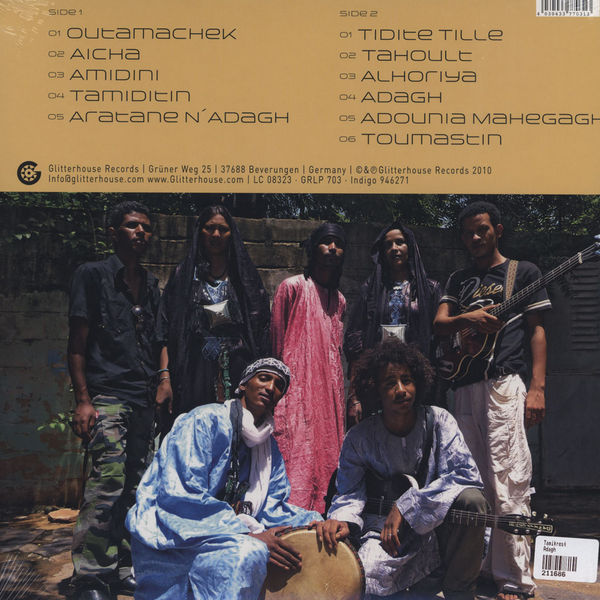
Vinilija @ Radio Marš: Tamikrest - Adagh (Glitterhouse 2010)


TAMIKREST
When Touareg children arrive in the public Malian schools, they are soon confronted by an administration that refuses to see the realities our people subjected. The youngsters are subject to racism and marginalisation every day at school.
A few of us who attended the private school of Tinzawaten, initiated by the Tuareg elite and financed by European and French funds, followed the road led to Tamikrest.
The rebellion of 23rd of May 2006, caused by the nonapplication of the peace treaty of 1992, shows the tragedy that my people undured since the French colonisation. Because of the rebellion, many families had to flee, and the children were forced to quit school.
Tamikrest, which means in Tamasheq "Union" and "Knot", was created following these events. Our hope is to have the world listen to our revolutionary songs, which reflect the harsh life conditions that our people endure. Tamikrest also sings the desert - so fundamental for the Tuareg - praises of love, beauty, and the goodness of nomadic culture. 


REBEL KIDAL
Rebel Kidal is the name, sometimes given to the capital of the 8th region of Mali, also called "Azawad". In this dry and barren northern region, living conditions are difficult: No river, no asphalt roads, and the recently built hospital of Kidal is and empty shell. People must travel over 300km to have a tooth removed or an x-ray done. The popualtion are mostly "Kel Tamasheq" (Touaregs) also known as the "Kel Adagh" (those of the hills) in reference to the mountains "l'Adrar des lforas".
These nomadic breeders endured successively the great droughts of 1973 and 1984. The loss of livestock, government repression, and the difficulty to maintain their traditions, led to the first rebellion in 1963 soon after the independence of young Mali. Again a rebbelion in the 1990's, particulary violent, forced people to flee into exile. After the peace treaty signature, though Kidal was recognised as a regional capital, growing undervelopment, and the lack of opportunities for the youth led to another insurrection in May 2006. Once again the various parties managed to come to an agreement, but tensions continued to grow until 2008 when new conflicts erupted between the army and ex-rebels. Beyond their hopes for a decent existence, The Tuaregs wish above all to save and defend their culture.
Bilqis

Recorded at Studio Bogolan, Bamako, Mali, July 21 - 26, 2009
Produced by Chris Eckman
Translations by Melissa Wainhouse

Tamikrest:
Ousmane Ag Mossa - Vocals, Lead Guitar
Aghaly Ag Mohamadine - Percussion, Drums, Backing Vocals
Cheikhe Ag Tigly - Bass, Backing Vocals
Mossa Ag Borayba - Rhythm Guitar, Backing Vocals
Mossa Ag Ahmed - 2nd Rhythm Guitar, Backing Vocals
Fatma Walette Cheikhe - Backing Vocals
Bassa Walette Abdamou - Backing Vocals
with
Ibrahim Ahmed (Pino) - Calabash  On 7
Chris Eckman - Percussion On 2 & Organ on 5
Hugo Race - Slide Guitar On 11
All songs by Ousmane Ag Mossa


A1 OUTAMACHEK
Oh Lord, You who sees all things,
You who have power and strength,
help the Touareg.
Since the beginning of existence
he lives in barren regions with no means.
He watches a world in movement evolving beyond him,
while he remains trapped in ignorance.

A2 AICHA
If Aicha was in a valley,
she would be the flower growing by the water.
If I could have two hearts,
I would live with one,
and offer the other to Aicha,
so that  she stays forever happy.

A3 AMIDINI
My friend, what is this pitiful world
which ignores your joy and leaves you in a mystery?
Tell love, master of my soul:
To take care of you and of my heart
Remember my love, the pain that fills my heart,
I send you love.
Remember all the memories and the impressions
that you left my heart in pain.

A4 TAMIDITINE
My beloved, what have you done?
I can't believe you are the author.
My heart asks: What pain is this?
He feels abondoned in a dry desert.
My soul answers: such is life;
what seems to you unbelievable
can one day be possible.
Never could I imagine that my heart and soul
could suffer in this way.

A5 ARATANE N'ADAGH
Oh! How pitiful they are,
the children of L'Adagh.
Since their birth they suffer and
have known only drought.
Foreign cities send help such as Lyon and Les Ulis.
Let's fight against ignorance,
which oppresses the children of L'Adagh
because their greatest worry is the lack of knowledge.

B1 TIDITE TILLE
Truth exists, you hide it because
you don't like it, and you don't admit it.
So much suffering that you've dismissed.
You have ignored our people in their torment.
You have left our people in their pain.
But despite the abandonment we feel
and the drought we endure,
we love our land above all.

B2 TAHOULTE
I greet my beloved, whose love rules my heart.
My heart is in longing abandoned in desperation.
She is more beatiful then the gaze of an antelope
standing by a pond surrounded by rocks.

B3 ALHORYA
I will say it and i'll say it again:
freedom will come even if we leave orphans behind.
Our land is not for sale.
Freedom will be our heritage.
Each of you hear what i say,
freedom will come when my people will have independence.

B4 ADAGH
Adagh, why do aour people,
because of your enemy, become rivals?
Despite each revolution and so close to success,
we end up despising each other like enemies.
We fight for glory and sow discord
and our rancour will lead us to our extinction.
Adagh, what have become of your people
who used to believe in the same values?

B5 ADOUNIA MAHEDJAGH
Oh, World, what can I do for my sad heart,
drowned in despair?
The day passes like a year,
and my endless worries accompany me all night long.

B6 TOUMASTIN
This existence brings no joy and no unhappiness,
wait and see.
My people are in conflict and divided,
they are enemies to each other.
Your best friend
with whom you share so many memories,
with whom you share so many memories;
one day will become your worst enemy.




27.5.12

Vinilija @ Radio Marš: Tone Janša IV

TONE JANŠA QUARTET - GOA (JUGOTON 1983)


A1 GOA (Tone Janša)
Soloists:
Tone Janša ss
Bernd Dietrich b
A2 TRAININ' (Tone Janša)
Soloists:
Tone Janša ts
Slavko Avsenik jun. p
A3 YATRA (Tone Janša)
Soloists:
Dejan Pečenko p
Tone Janša shinay

B1 STROLL AND FIGHT (Tone Janša)
Soloists:
Slavko Avsenik jun. p
B2 BLACK TIME (Tone Janša)
Soloists:
Tone Janša fl
Andy Lummp p
Adelhard Roidinger b

Tone Janša celebrates the tenth anniversary of the existence of his quartet. On this record he represents the last four versions of his group, which changes its members according to need:
Tone Janša ss, Dejan Pečenko p, Bernd Dietrich b, Gerhard Wennemuth dr on "Goa" A1
Tone Janša ts, Slavko Avsenik jun. p, Karel Novak b, Ratko Divjak dr on "Trainin'" A2 and "Stroll and flight" B2
Tone Janša fl, Andy Lummp p, Adelhard Roidinger b, Ratko Divjak dr on "Black time" B2
Tone Janša shinay, Dejan Pečenko p, Adelhard Roidinger b, Ratko Divjak dr on Yatra A3

After having finished his studies in Classical music and Jazz in Graz and after his Jazz studies at Boston's Berklee College of Music, Tone Janša returned to Yugoslavia, joined the RTV Ljubljana Big Band as saxophonist and devoted more time to his own music and quartet. He recorded in Ljubljana at North German radio station in Hamburg, in Trieste in numerous Yugoslav TV and radio studios. Further he played and recorded on Jazz Festivals at:

1974 the Polish "Jazz nad Odra", in Graz where he played in the international Big Band under the direction of Slide Hampton
1975 in Debrecen and Nagykanisza in Hungary, Ljubljana Jazz Festival, Finland "Pori Jazz Festival"
1976 in Prague with Gustav Brom's Big Band, Ljubljana and Belgrade Jazz Festival
1978 UER/EBU (Europena Big Band) in Perugia - Italy
1979 Yugoslav Jazz Festivals (Maribor, Novi Sad, Belgrade, Zagreb)
1980 Yatra Jazz Festival in Bombay + an extensive tour of India Burghausen Jazz Festival in Germany
1981 Berlin Jazz Festival "Jazz Buhne Berlin 81", Austrian Jazz Days in Linz, Aarhus EBU Jazz Festival in Denmark
1982 Saalfelden in Austria, Ljubljana and Maribor Jazz Festival, Nagykanisza and Sombathely in Hungary and many others

Tone Janša is without doubt one of the most promising jazz musicians in our country. He represents a new trend, which one readily recognizes after having listened to his music. His music is fresh, dynamic, and modally as well as rhythmically very interesting. He composes and plays his own music.

JANEZ GREGORC

Down Beat (USA)
Yugoslavian saxophonist Tone Janša, who has studied at Berklee College owes much to Trane-ish manner of building a solo use of trills, some of his phrasing -yet there often is not- Trane-ish edge to his tone a bite that owes a little to Eastern European folk reed instruments.

Mid-Day (Bombay-India)
Tone Janša a big name in Yugoslavian jazz made his mark on Yatra by his well knit coordination with his quartet and his original compositions. This was a group that didn't belive doing their own thing at the expense of the audience but concentrated instead on murmuring into a pleasant whole.

Neue Zaitschrift fur musick (BRD)
Den zweiten Abend (Beim  Burghausener jazz Festival) eroffnete internationale Gruppe um den jugoslawischen Saxophonisten Tone Janša. Die Stucke des Quartetts sind durchwegs Eigenkompositionen von Tone Janša, die stilistisch im modalen Bereich angesiedelt sind, durch die Einbeziehung von der Musik vieler jungerer Gruppen unterscheiden. Unuberhorbar der Einfluss der jugoslawischen Folklore die der Music von Tone Janša einen eigenwilligen Charakter verleit.

Neue Zeit (Austria)
Perfektion un Lockerheit. Es ist relativ selten dass vier Musiker dermassen aufeinander eintugehen verstehen eine Ausgewogenhiet war die Folge, die als Basis fur Janšas weitlaufige Improvisationen diente. Das vielzitierte Zusammentreffen bzw. Spielfreude wurde von dem Quartet uberzeugend zum Leben erweckt. Janšas eruptive Klangkaskaden wirbelten um die Holzkonstruktion des Raumes. Soli und kompaktes Zusammenspiel erganzten sich ungezwungen in logischer Folge.

Jazz B. Berlin
Ein 50 minutiges "Hormusik" Solo
An sudslawischer Folklore orientierte Quartett des jugoslawischen Saxophonisten Tone Janša verband in seinem Spiel Virtuositat und kreative improvisationen aufs das glucklichste.

Jazzpodium (BRD)
In seiner Stilistik und Spielauffasung sowohl auf dem Sopranals auf dem Tenorsaxophon, das in seiner auselrichen Abgenutzheit von einer bewegten instrumenten vergangenheit zeugt, verdankt Tone, gegen wartig mit zahlreichen Rundfuk-und Festivalengegements sicherlich einer der richtungsweisenden Jazzmusiker seines Landes, viel John Coltrane, mit dem er sich durch technische Perfektion, souverane Pharsierung, figural arabeske Solodurchfuhrung und fast hymnisch anmutende Expressivitat verbunde wiess.

Vinilija @ Radio Marš: Tone Janša III

TONE JANŠA - PATTERN (HELIDON 1979)


A1 NOČ (Night) (Tone Janša)
A2 LABIRINT ( Labyrinth) (Tone Janša)
A3 KJE SO TISTE STEZICE (Where Are Those Little Paths) (Tone Janša)
A4 PARABOLA (Parabole) (Tone Janša)

B1 PATTERN (Tone Janša)
B2 DAN IN VZGON (Day and Buoyancy) (Tone Janša)
B3 ROM (Gypsy) (Tone Janša)
B4 POTOP (Sinking) (Tone Janša)

Tone Janša ts, ss, fl
Andre Jeanquartier p
Ewald Oberleitner b
Miroslav Karlović dr


For this album, Tone Janša's aim was to select recording which greatly vary from one another. His intent to make a versatile record has surely succeeded. Harmoniously and rhythmically, the record includes current and modern music, from the eight note feeling with contemporary harmonies, to madal jazz in complicated rhythms, and bi-tonal to atonal free jazz. At first glance, the record overwhelms the listener with an abundance of musical material. The pieces are intricately composed and each musician contributes his individual talents, producing a kaleidoscope of sound.

"Night" is a lyrical composition for tenor sax, in two parts with a straight eighth note rhythm. Part A has sicteen bars, the first eight repeat an ostinato bass in varying harmonies. Part B follows with four bars. The two solos are by the pianist and Janša. The theme is then repeated and is followed by a coda.

"Labyrinth" is an interwoven composition, consisting of many thematic and transitional elements. It is characterized by a labyrinthine structure, allowing plenty of room for solos on piano, drums and soporano sax. Of special interes in Tone's solo, is a section utilizing some kind of phrygian mode, with the addion of a major third.

"Where Are Those Little Paths" is very interesting use of Slovene folk song in jazz. Whit interesting reharmonization the liric song becomes a jazz ballad. Arranger plays quite free cadenca and then the coda follows.

"Parabole" is a composition for soprano sax with the heavy emphasis on drums, in the first part. The second part is in straight rhythm. The solos are on soprano, piano and bass.

The RTV Ljubljana Big Band, conducting by Jože Privšek surprises us on side B, with Janša's 10/4 composition, "Pattern". Tone starts it on flute, the band follows with the theme, and then Tone appears again on tenor. The climax is reached when the orchestra repeats the theme. The music calms down and dies out.

The following two selections were performed as one, live, at the Ljubljana '78 Jazz Festival. "Day" is a modern composition beginning with arco bass and flute, with the addition later on, of piano and drums. In a collective improvisation, the soloists use scales from the basic mode in atonal playing, return then, reach the climax and fade away.

"Buoyancy" is a piece with a break on tenor and a rather complex modal theme in ABCD form, with D in 7/4 meter. Solos are on tenor, and piano, followed by a break for tenor and a coda. "Day" and "Buoyancy" live from Jazz-Festival, Ljubljana '78.

"Gypsy" is a bi-tonal composition with gypsy music influence, featuring soprano sax. In the third part, the "gypsy minor" scale is used, and at the end, the composer's own composite scale.

"Sinking" is a free jazz composition, starting and ending melodiously with a collectively inspired improvisation by the quartet.

This album reveals a wide range of musical material and presents Janša as a very balanced musician, composer, and improvisator, who is capable of combining very different musical approaches, resulting in meaningful expression. This record of international team work is a valid representation of his credo.

JANEZ GREGORC

Vinilija @ Radio Marš: Tone Janša II

TONE JANŠA KVARTET - BEOGRADSKI JAZZ FESTIVAL '78 (RTB 1978)


A1 MOTIV (Motive)
A2 SEDMINA (Seventh Day)

B1 MRAK (Dusk)
B2 VIZIJA (Vision)
B3 VZGON (Buoyancy)
B4 SONCE (Sun)

Compositions by Tone Janša

The times in yugoslav jazz music have changed. Sympathetic jazz listening and the amateur playing of the musicians, based mostly on talent, has, due to a specialized education, evolved into professional playing, with numerous opportunities to participate in international jazz festivals, modern studio work, and in professional concerts. At this stage in the development of European jazz we can add another expressive jazz talent and realize the importance of Tone Janša on our jazz scene.

Tone Janša is representative of a new generation of jazz musicians. The development of his music is logical for our modern times. He received his first playing experience in a big band in Kranj - a city which has provided jazz with some outstanding names. He continued his music education in Ljubljana, later at the Institute of Jazz in Graz. In Graz he studied tenor-saxophone and other instruments of the same family. He successfully completed his studies in Graz, first in classical music (1974) and than in jazz (1975). These studies provided him with the fundamentals for realising his own projects, including the formation of his own small combo, an important role in Radio-Television Ljubljana's Big Band and in his serious composer's work.

Tone Janša is a fully developed musical personality on our contemporary jazz scene. He is, without doubt, our leading tenor-saxophonist and multi-instrumentalist, with an admirable technique and talent for improvisation. He plays flute and soprano-saxophone as well as tenor-saxophone. He is musician with a lot of energy and full awareness for modern free improvisation. The repertoire of this, his second album, gives a good picture of his fresh and dynamic music, which is modally and rhythmically very interesting. Janša has already proven his abilities many times before on several domestic and foreign stages.

On this album, Tone Janša is presented with his quartet, consisting of collegues form Graz: pianist, Andre Jeanquartier from Switzerland, bassist, Ewald Oberleitner and drummer Johann Preininger, both Austrians. Preininger is replaced in some selections, by the talented young Yugoslav, Miro Karlović. Janša is obviously selecting experienced musicians, who are primarily able to realize able to realize his ideas, as well as contributing vital, individual solo work.

Concerning repertoire and sound, Janša and his quartet are presented on this album in a wide spectrum, from a lyrical ballad with the tender flute's tone, to robust improvisation with powerful tone in a very fast tempo and complicated rhytmical formulas. The program selected for this album therefore presents a wide range of Janša's musical creativity. The first selection MOTIV (recorded in the Zagreb studio "Lisinski") shows the composer as a real tenor saxophonist. So does the following SEDMINA, written in 7/4 meter and medium tempo. The "B" side of this album includes four originals of a wide and dynamic nature. MRAK is a ballad in a slow-medium tempo, where we hear the composer as a flutist. After the rubato introduction, the music goes in 13/4 meter, consisting of 6/4 and 7/4 formulas. In the following composition VIZIJA, the sound, metrical construction and tempo are changing. Having already appeared as tenor-saxophonist and flutist, the composer plays soprano in the meter of eighths, medium tempo and pop-rock rhythm. VZGON is an interesting and dynamically inventive theme, constructed in ABCD form - in four parts, where the fourth one is in 7/4. The introduction is a tenor-saxophone solo, then the music goes into tempo. The album ends with another original Janša's called SONCE, where once again the composer is heard on tenor-saxophone, and Johann Preininger on drums, as in the first two numbers. It starts as a ballad and then goes into 10/4 with an Ostinato figure. At the conclusion, it returns to its original ballad form. This album well expresses the personality of Tone Janša as a musician, composer and leader.

It is, by all means another welcome document of our documentary jazz.

Mladen Mazur

Vinilija @ Radio Marš: Tone Janša I

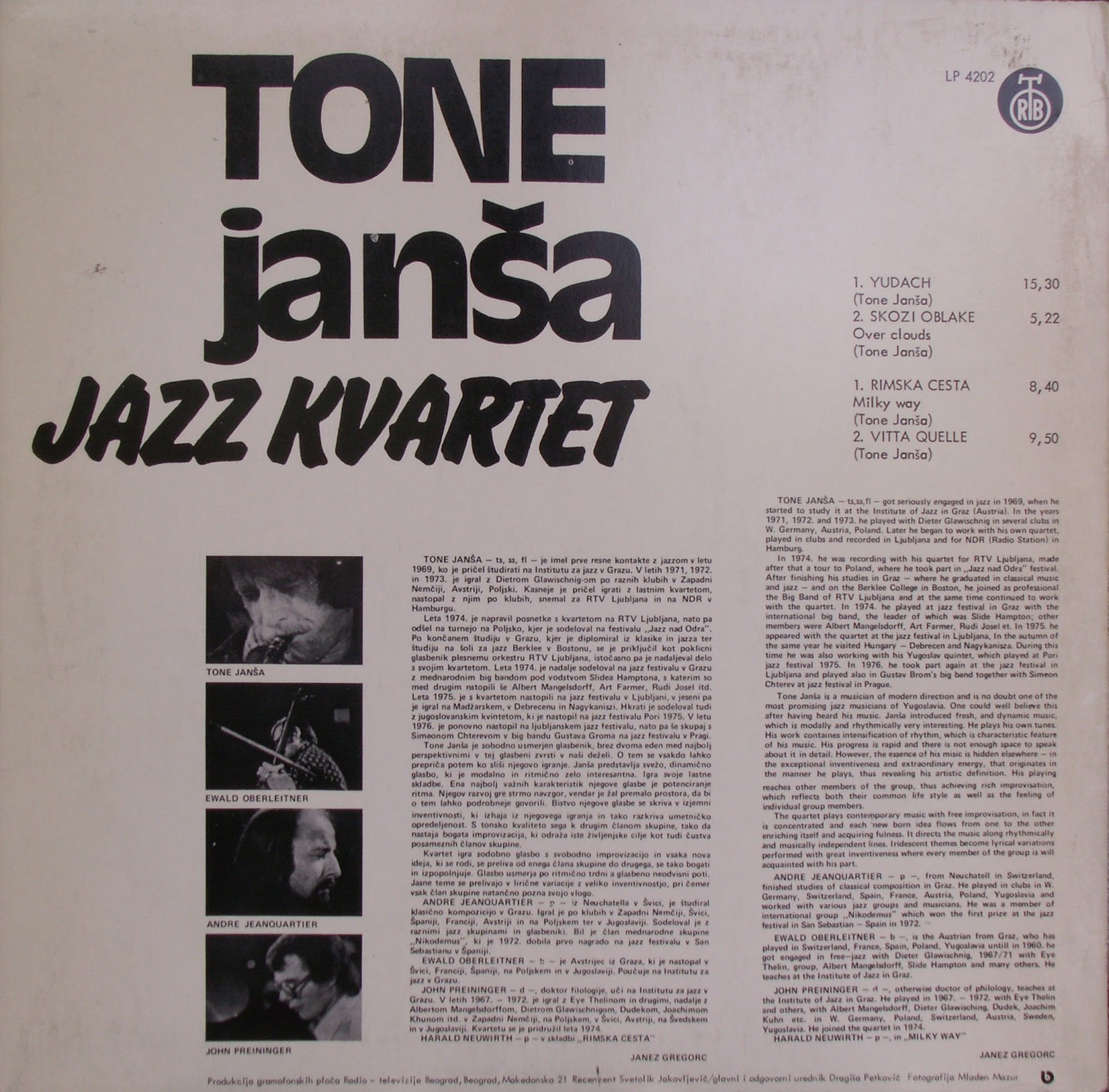
TONE JANŠA - JAZZ KVARTET (RTB 1977)


A1 YUDACH (Tone Janša)
A2 SKOZI OBLAKE ( Over clouds) (Tone Janša)
B1 RIMSKA CESTA (Milky way) (Tone Janša)
B2 VITTA QUELLE (Tone Janša)

TONE JANŠA - ts, ss, fl -, got seriously engaged in jazz in 1969, when he started to study it at the Institute of Jazz in Graz (Austria). In the years 1971, 1972, and 1973, he played with Dieter Glawischnig in several clubs in W. Germany, Austria, Poland. Later he began to work with his own quartet, played in clubs and recorded in Ljubljana and for NDR (Radio Station) in Hamburg.
In 1974, he was recording with his quartet for RTV Ljubljana, made after that a tour to Poland, where he took part in "Jazz nad Odra" festival. After finishing his studies in Graz - where he graduated in classical music and jazz - and on Berklee College in Boston, he joined as professional the Big Band of RTV Ljubljana and at the same time continued to work with the quartet. In 1974, he played at jazz festival in Graz with the international big band, the leader of which was Slide Hampton; other members were Albert Mangelsdorff, Art Farmer, Rudi Josel etc. In 1975, he appeared with the quartet at the jazz festival in Ljubljana, in the autumn of the same year he visited Hungary - Debrecen and Nagykanisza. During this time he was also working with his Yugoslav quintet, which played at Pori jazz festival 1975. In 1976, he took part again at the jazz festival in Ljubljana and played also in Gustav Brom's big band together with Simeon Chterev at jazz festival in Prague.

Tone Janša is a musician of modern direction and is no doubt one of the most promising jazz musicians of Yugoslavia. One could well believe this after having heard his music. Janša introduced fresh, and dynamic music, which is modally and rhythmically very interesting. He plays his own tunes. His work contains intensification of rhythm, which is characteristic feature of his music. His progress is rapid and there is not enough space to speak about it in detail. However, the essence of his music is hidden elsewhere - in about it in detail. However, the essence of his music is hidden elsewhere - in the exceptional inventiveness and extraordinary energy, that originates in the manner he plays, thus revealing his artistic definition. His playing reaches other members of the group, thus achieving rich improvisation, which reflects both their common life style as well as the feeling of individual group members.

The quartet plays contemporary music with free improvisation, in fact it is concentrated and each new born idea flows from one to the other enriching itself and acquiring lines. Iridescent themes become lyrical variations performed with great inventiveness where every member of the group is will acquainted with his part.

ANDRE JEANQUARTIER - P -, from Neuchatell in Switzerland, finished studies of classical composition in Graz. He played in clubs in W. Germany, Switzerland, Spain, France, Austria, Poland, Yugoslavia and worked with various jazz groups and musicians. He was a member of international group "Nikodemus" which won the first prize at the jazz festival in San Sebastian - Spain in 1972.

EWALD OBERLEITNER - b -, is the Austrian from Graz, who has played in Switzerland, France, Spain, Poland, Yugoslavia until in 1960, he got engaged in free-jazz with Dieter Glawischnig, 1967-1971 with Eye Thelin, group, Albert Mangelsdorff, Slide Hampton and many others. He teaches at the Institute of Jazz in Graz.

JOHN PREININGER - d -, otherwise doctor of philology, teaches at the Institute of Jazz in Graz. He played in 1967-1972 with Eye Thelin and others, with Albert Mangelsdorff, Dieter Glawischnig, Dudek, Joachim Kuhn etc. in W. Germany, Poland, Switzerland, Austria, Sweden, Yugoslavia. He joined the quartet in 1974.

HARALD NEUWIRTH - p -, in "MILKY WAY"

JANEZ GREGORC