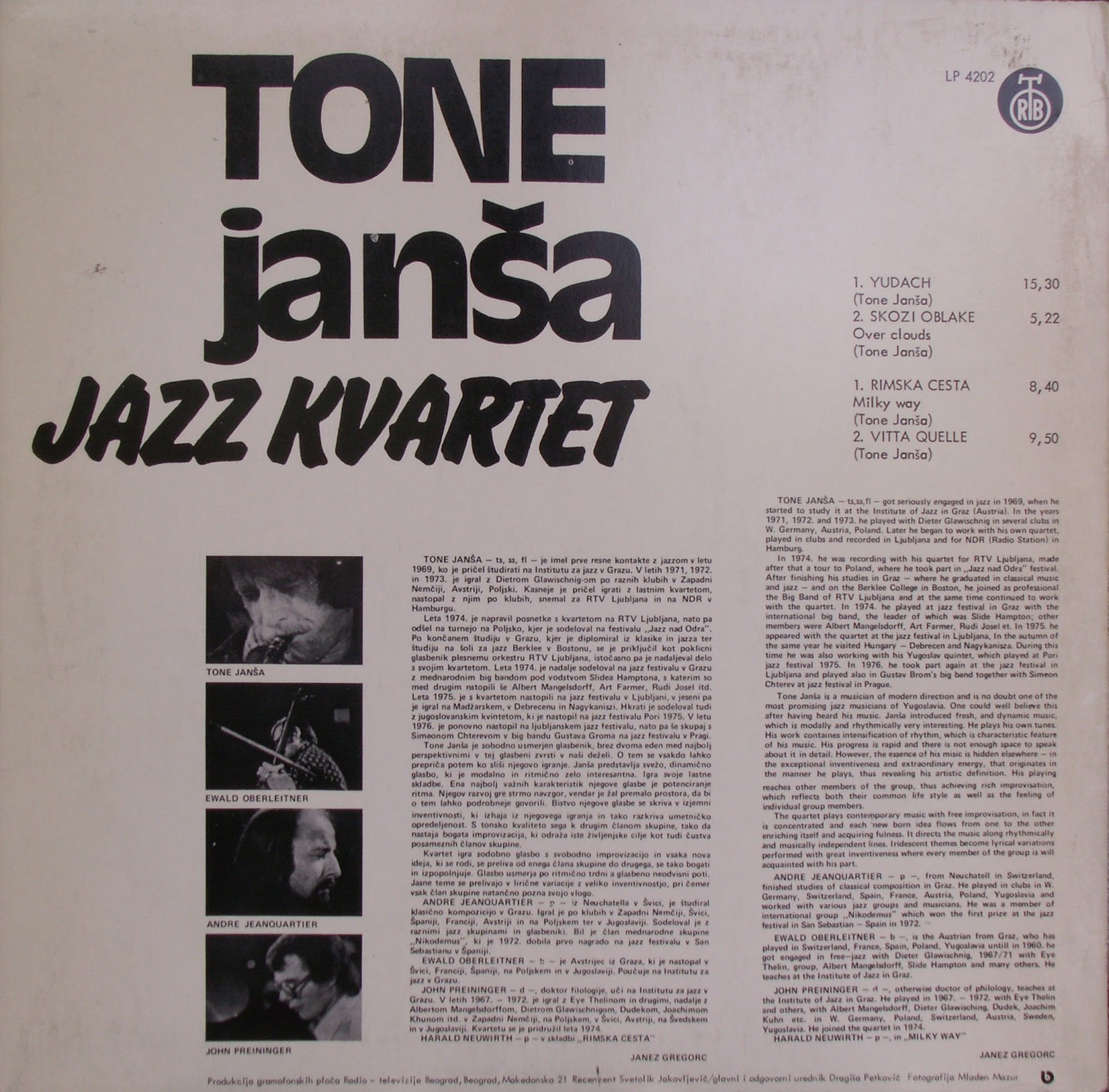
TONE JANŠA KVARTET - BEOGRADSKI JAZZ FESTIVAL '78 (RTB 1978)


A1 MOTIV (Motive)
A2 SEDMINA (Seventh Day)
B1 MRAK (Dusk)
B2 VIZIJA (Vision)
B3 VZGON (Buoyancy)
B4 SONCE (Sun)
Compositions by Tone Janša
The times in yugoslav jazz music have changed. Sympathetic jazz listening and the amateur playing of the musicians, based mostly on talent, has, due to a specialized education, evolved into professional playing, with numerous opportunities to participate in international jazz festivals, modern studio work, and in professional concerts. At this stage in the development of European jazz we can add another expressive jazz talent and realize the importance of Tone Janša on our jazz scene.
Tone Janša is representative of a new generation of jazz musicians. The development of his music is logical for our modern times. He received his first playing experience in a big band in Kranj - a city which has provided jazz with some outstanding names. He continued his music education in Ljubljana, later at the Institute of Jazz in Graz. In Graz he studied tenor-saxophone and other instruments of the same family. He successfully completed his studies in Graz, first in classical music (1974) and than in jazz (1975). These studies provided him with the fundamentals for realising his own projects, including the formation of his own small combo, an important role in Radio-Television Ljubljana's Big Band and in his serious composer's work.
Tone Janša is a fully developed musical personality on our contemporary jazz scene. He is, without doubt, our leading tenor-saxophonist and multi-instrumentalist, with an admirable technique and talent for improvisation. He plays flute and soprano-saxophone as well as tenor-saxophone. He is musician with a lot of energy and full awareness for modern free improvisation. The repertoire of this, his second album, gives a good picture of his fresh and dynamic music, which is modally and rhythmically very interesting. Janša has already proven his abilities many times before on several domestic and foreign stages.
On this album, Tone Janša is presented with his quartet, consisting of collegues form Graz: pianist, Andre Jeanquartier from Switzerland, bassist, Ewald Oberleitner and drummer Johann Preininger, both Austrians. Preininger is replaced in some selections, by the talented young Yugoslav, Miro Karlović. Janša is obviously selecting experienced musicians, who are primarily able to realize able to realize his ideas, as well as contributing vital, individual solo work.
Concerning repertoire and sound, Janša and his quartet are presented on this album in a wide spectrum, from a lyrical ballad with the tender flute's tone, to robust improvisation with powerful tone in a very fast tempo and complicated rhytmical formulas. The program selected for this album therefore presents a wide range of Janša's musical creativity. The first selection MOTIV (recorded in the Zagreb studio "Lisinski") shows the composer as a real tenor saxophonist. So does the following SEDMINA, written in 7/4 meter and medium tempo. The "B" side of this album includes four originals of a wide and dynamic nature. MRAK is a ballad in a slow-medium tempo, where we hear the composer as a flutist. After the rubato introduction, the music goes in 13/4 meter, consisting of 6/4 and 7/4 formulas. In the following composition VIZIJA, the sound, metrical construction and tempo are changing. Having already appeared as tenor-saxophonist and flutist, the composer plays soprano in the meter of eighths, medium tempo and pop-rock rhythm. VZGON is an interesting and dynamically inventive theme, constructed in ABCD form - in four parts, where the fourth one is in 7/4. The introduction is a tenor-saxophone solo, then the music goes into tempo. The album ends with another original Janša's called SONCE, where once again the composer is heard on tenor-saxophone, and Johann Preininger on drums, as in the first two numbers. It starts as a ballad and then goes into 10/4 with an Ostinato figure. At the conclusion, it returns to its original ballad form. This album well expresses the personality of Tone Janša as a musician, composer and leader.
It is, by all means another welcome document of our documentary jazz.
Mladen Mazur


A1 MOTIV (Motive)
A2 SEDMINA (Seventh Day)
B1 MRAK (Dusk)
B2 VIZIJA (Vision)
B3 VZGON (Buoyancy)
B4 SONCE (Sun)
Compositions by Tone Janša
The times in yugoslav jazz music have changed. Sympathetic jazz listening and the amateur playing of the musicians, based mostly on talent, has, due to a specialized education, evolved into professional playing, with numerous opportunities to participate in international jazz festivals, modern studio work, and in professional concerts. At this stage in the development of European jazz we can add another expressive jazz talent and realize the importance of Tone Janša on our jazz scene.
Tone Janša is representative of a new generation of jazz musicians. The development of his music is logical for our modern times. He received his first playing experience in a big band in Kranj - a city which has provided jazz with some outstanding names. He continued his music education in Ljubljana, later at the Institute of Jazz in Graz. In Graz he studied tenor-saxophone and other instruments of the same family. He successfully completed his studies in Graz, first in classical music (1974) and than in jazz (1975). These studies provided him with the fundamentals for realising his own projects, including the formation of his own small combo, an important role in Radio-Television Ljubljana's Big Band and in his serious composer's work.
Tone Janša is a fully developed musical personality on our contemporary jazz scene. He is, without doubt, our leading tenor-saxophonist and multi-instrumentalist, with an admirable technique and talent for improvisation. He plays flute and soprano-saxophone as well as tenor-saxophone. He is musician with a lot of energy and full awareness for modern free improvisation. The repertoire of this, his second album, gives a good picture of his fresh and dynamic music, which is modally and rhythmically very interesting. Janša has already proven his abilities many times before on several domestic and foreign stages.
On this album, Tone Janša is presented with his quartet, consisting of collegues form Graz: pianist, Andre Jeanquartier from Switzerland, bassist, Ewald Oberleitner and drummer Johann Preininger, both Austrians. Preininger is replaced in some selections, by the talented young Yugoslav, Miro Karlović. Janša is obviously selecting experienced musicians, who are primarily able to realize able to realize his ideas, as well as contributing vital, individual solo work.
Concerning repertoire and sound, Janša and his quartet are presented on this album in a wide spectrum, from a lyrical ballad with the tender flute's tone, to robust improvisation with powerful tone in a very fast tempo and complicated rhytmical formulas. The program selected for this album therefore presents a wide range of Janša's musical creativity. The first selection MOTIV (recorded in the Zagreb studio "Lisinski") shows the composer as a real tenor saxophonist. So does the following SEDMINA, written in 7/4 meter and medium tempo. The "B" side of this album includes four originals of a wide and dynamic nature. MRAK is a ballad in a slow-medium tempo, where we hear the composer as a flutist. After the rubato introduction, the music goes in 13/4 meter, consisting of 6/4 and 7/4 formulas. In the following composition VIZIJA, the sound, metrical construction and tempo are changing. Having already appeared as tenor-saxophonist and flutist, the composer plays soprano in the meter of eighths, medium tempo and pop-rock rhythm. VZGON is an interesting and dynamically inventive theme, constructed in ABCD form - in four parts, where the fourth one is in 7/4. The introduction is a tenor-saxophone solo, then the music goes into tempo. The album ends with another original Janša's called SONCE, where once again the composer is heard on tenor-saxophone, and Johann Preininger on drums, as in the first two numbers. It starts as a ballad and then goes into 10/4 with an Ostinato figure. At the conclusion, it returns to its original ballad form. This album well expresses the personality of Tone Janša as a musician, composer and leader.
It is, by all means another welcome document of our documentary jazz.
Mladen Mazur